 15 Feb 2026
In Visakhapatnam, the sea is more than scenery; it is a partner in progress. A decade ago, Cyclone Hudhud ripped across the coast, tearing down power lines, uprooting trees, and scarring the city deeply. The state eventually tallied losses in the tens of thousands of crores, and the city’s self-image took a severe beating with them. Yet in February 2016, Visakhapatnam stood tall to host the International Fleet Review (IFR). As the ships dressed overall and bands struck up on Ramakrishna Beach, the city’s mood shifted from shell-shocked to forward-looking. Prime Minister Narendra Modi captured that hinge moment in his address at the International City Parade in Visakhapatnam on 07 February 2016: “A little over a year ago, we saw the full fury of the ocean. Today, we are discussing how the oceans can be a source of economic prosperity for all of us.”
From Shock to Showcase
Cyclone Hudhud struck on 12 October 2014 with winds topping 180 kmph, crippling infrastructure, flooding the airport, and stripping the city of its green cover. Government and multilateral assessments placed the losses between ₹14,800 and ₹21,900 crore, leading to a $250 million World Bank–supported recovery programme. The rebuilding was forward-looking, embedding resilience through underground cabling, LED streetlighting, and disaster-ready public works.
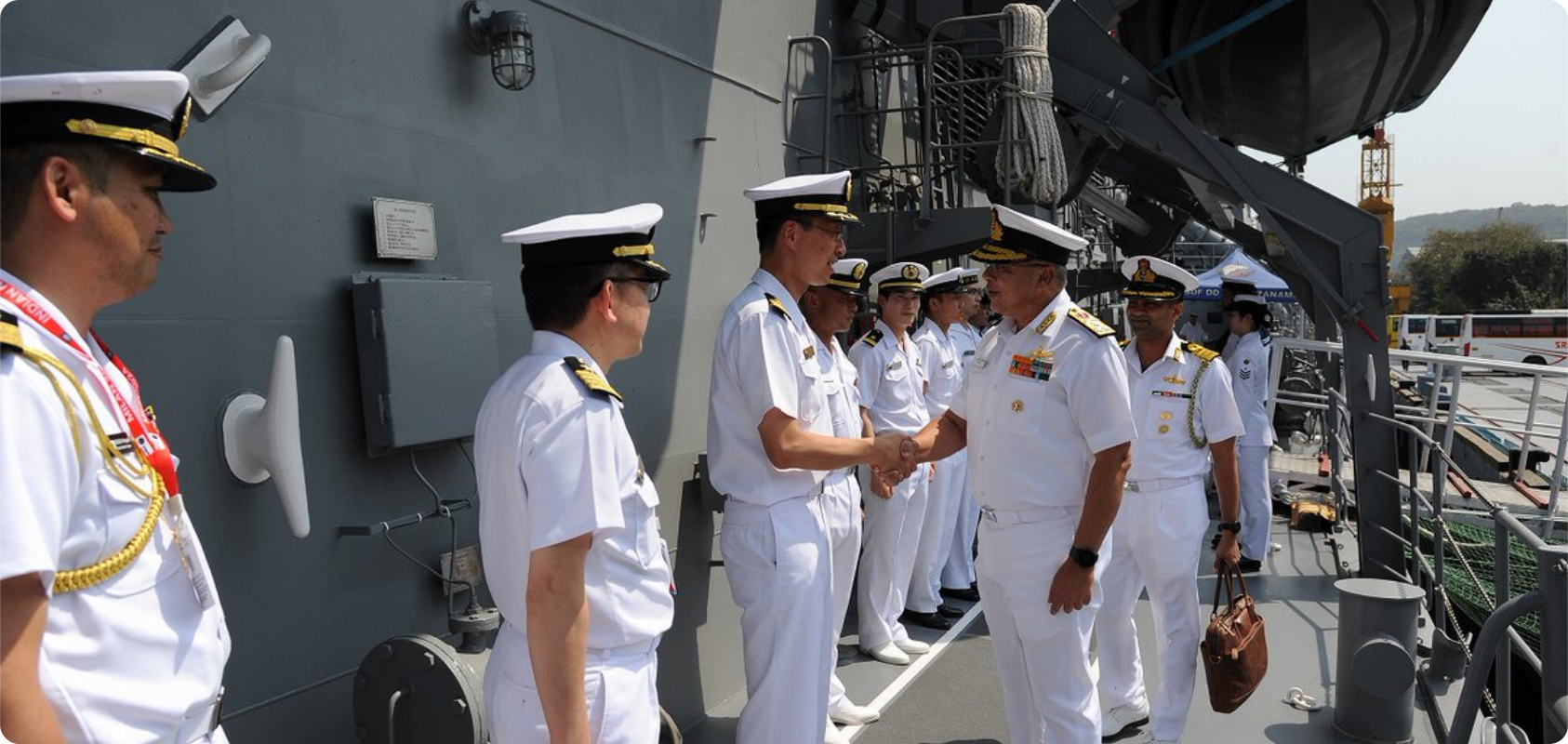
Less than two years later, the International Fleet Review of 2016 opened a new chapter. More than 45 foreign navies represented by senior delegates and 24 ships joined over 70 Indian warships, creating an unprecedented concentration of maritime power on India’s east coast. The programme wove together an International Presidential Review at sea, an International Maritime Conference, and a public International City Parade along the Beach Road. Symbolism carried weight, but so did investment: roads, promenades, and public spaces were transformed in the lead-up — a playbook Vizag City Administration has continued to refine.
Infrastructure Deadlines
Big-ticket naval events have repeatedly served as ‘hard stops’ that align state and city agencies. Before IFR 2016, and again ahead of MILAN 2024, the Greater Visakhapatnam Municipal Corporation (GVMC) and the Visakhapatnam Metropolitan Region Development Authority (VMRDA) accelerated road resurfacing, lighting, footpaths, murals, and junction upgrades — city-making that outlasts the parades.
The resilience agenda has deepened too. Post-Hudhud efforts such as the expansion of underground utilities and LED retrofits have continued apace; a ₹200-crore seawall at Bheemili is in the pipeline to curb coastal erosion; and the ₹498-crore International Finance Corporation–backed Madhurawada sewerage project is now gaining momentum. These may not grab headlines like a fleet review or city parade, but they are the quiet dividends of hosting high-stakes events on a predictable cadence.
Tourism as a Maritime Mile
If Ramakrishna Beach is Vizag’s calling card, the Indian Navy has helped turn it into an evolving classroom. INS Kursura, South Asia’s first submarine museum, was grounded here in 2002. Across the road sits the TU-142M Aircraft Museum, inaugurated in 2017; nearby stands the Sea Harrier Museum (2023), and the newly commissioned UH-3H helicopter Museum (Sep 2025). Together they form a curated ‘maritime mile’ that families can walk in an afternoon and remember for a lifetime. Each project reflects a three-way partnership: naval heritage, VMRDA execution, and GVMC stewardship.
MILAN 2024 amplified that tourism flywheel with a ‘MILAN Village’ of culture and cuisine, alongside another International City Parade. Exercises like MILAN foster camaraderie, cooperation and collaboration — not just between navies, but between a host city and the world it welcomes.
The Local Economy: Ships in Port, Money in Motion
When fleets come, so do delegations, suppliers, and spectators. IFR 2016 filled hotels and restaurants; one prominent hotel even hosted a gala dinner with the Prime Minister in attendance! This clustering of conclaves, showcases, and people-to-people events multiplies spending beyond room nights into transport, catering, staging, event management and so on. For local MSMEs, a week like MILAN often equals a tourist season.
Such surges also encourage permanent upgrades. New hospitality capacity and better-managed public spaces follow predictable peaks — exactly why aligning city budgets with naval calendars is smart governance. Put simply, the Navy’s timetables double as economic metronomes.
Naval Diplomacy: Vizag’s Global Handshake
MILAN began in the Andamans; by 2018, the Port Blair edition was already a 16-nation affair. Its move to Visakhapatnam in 2022 was no cosmetic shift: ENC’s infrastructure, deeper sea-room, and Vizag’s urban capacity made it inevitable. The Presidential Fleet Review of 2022 further cemented Vizag’s place in India’s maritime story.
Looking ahead, February 2026 is already circled as an important month in the city’s and Indian Navy’s shared calendar. Local authorities and the Indian Navy have confirmed that both IFR and MILAN will return bigger and better, with preparations underway and a global footprint expected to exceed the 2016 edition. The challenge now is to turn spectacle into durable capacity: cruise-capable berths, last-mile transit, bilingual wayfinding, and beachfront sanitation.
India’s chairing of the Indian Ocean Naval Symposium through 2026 - 2027 only strengthens Vizag’s hand. Even when meetings convene elsewhere, side-seminars and staff talks often gravitate to Eastern Naval Command (ENC) Headquarters. The net effect is steady diplomatic footfall — a soft-power dividend that endures beyond a single parade.
Partnership as Secret Sauce
None of this happens by military fiat. It takes the patient choreography of the Andhra Pradesh government, VMRDA, GVMC, district administration, and ENC — a relay in which each agency knows when to sprint. The administration plans include beautification, mobility, and security — not box-ticking, but a standard set since IFR 2016. The twin events are as much about showcasing Vizag as about majestic warships — a reminder that the brand of a maritime nation is anchored in its port cities.
Crucially, the Indian Navy doesn’t just ask; it gives. The museum cluster on Beach Road is a case in point — curated assets transferred or refurbished by the service, then managed with civic partners.
Looking Ahead 2026
For international cities such as Portsmouth, Brest, and Sydney, naval ceremony has long been more than pageantry — it has served as urban strategy: an occasion to repair streets, widen promenades, and renew civic pride. Visakhapatnam is beginning to reflect the same approach. Preparations for 2026 point to opportunities not only to complete essential works — sewage diversion and safe pedestrian access, but also to strengthen civic assets such as arterial roads, airport–port and naval base connectivity, expanded highways with flyovers, and the Sardar Vallabhbhai Patel Bridge. These links support daily life as much as they enable global gatherings.
When Hudhud howled, Vizag gritted its teeth. When the naval flags went up in 2016, it flew with pride over a rebuilt city. In 2022 and 2024, the city showed that ceremony and exercise can catalyse concrete change. And in 2026, Visakhapatnam could do what great port cities have done for centuries: turn the theatre of the sea into a better life on shore. For a city and its citizens, the most lasting salute any fleet can offer lies not in ceremonial displays, but in the quieter dividends of better infrastructure, resilient services, and a quality of life that endures long after the ships depart. All this is greatly backed by long term vision and steadying hands that work overtime for a Viksit Bharat.

 Chat with Navika
 India
India  Thailand
  France
  Iran
Iran  Bangladesh
  Australia
  South Africa
  United Arab Emirates