 22 Dec 2025
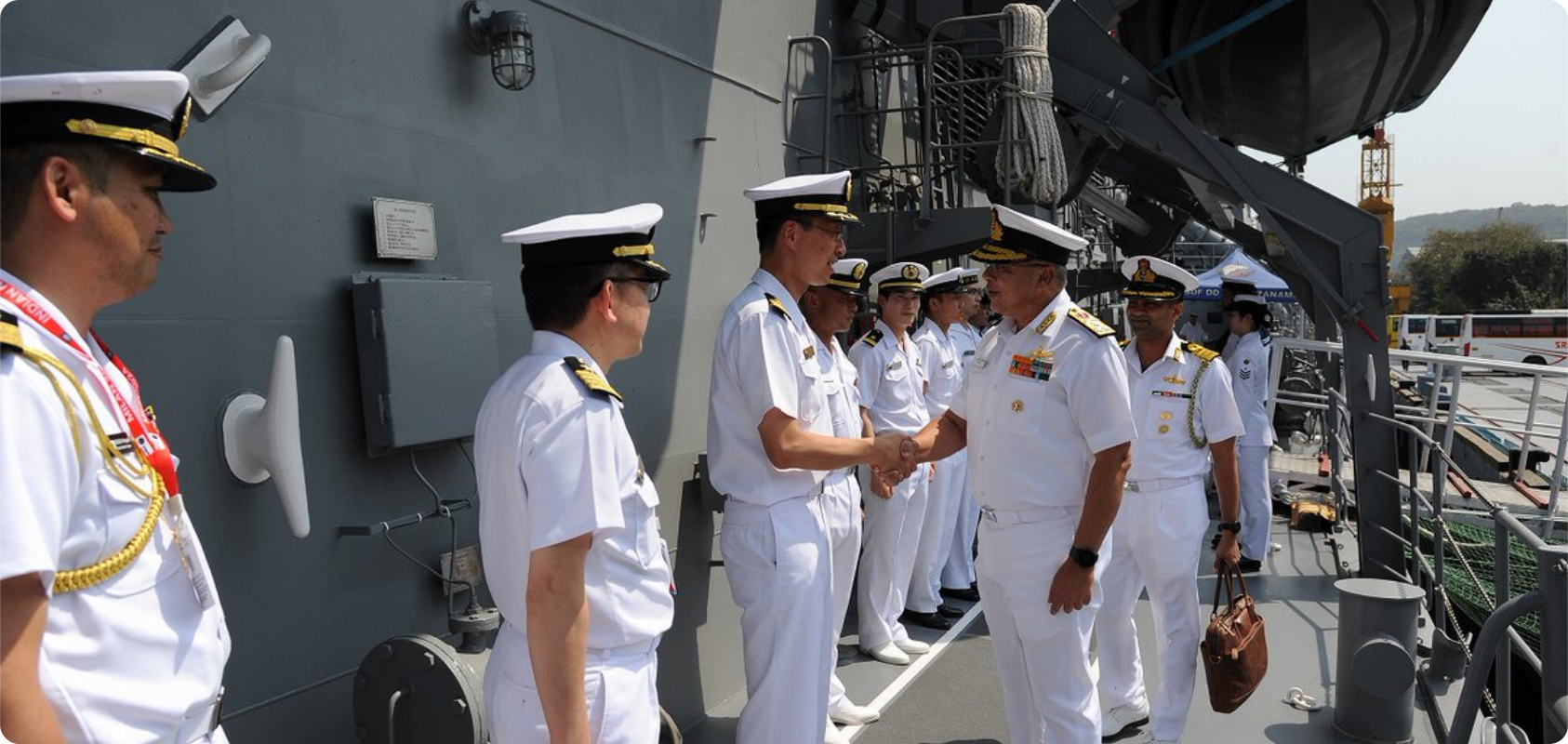
VISAKHAPATNAM: When the Indian Navy hosts the International Fleet Review (IFR) in Visakhapatnam in February 2026, the Bay of Bengal will once again emerge as a powerful symbol of maritime diplomacy, strategic intent and international cooperation.
Scheduled alongside Exercise MILAN and the Indian Ocean Naval Symposium (IONS) Conclave of Chiefs, the event is poised to be the largest maritime gathering ever hosted by India. Captain Akhilesh Menon R, associated with the IFR and MILAN Cell at the Eastern Naval Command, emphasises that the Fleet Review transcends mere ceremonial display. “To many, it may appear as a spectacle. But to those who understand the language of the sea, it represents identity, intent and India’s outlook at sea,” he emphasises.
India’s tradition of Fleet Reviews began in 1953, when President Rajendra Prasad reviewed 33 ships at Bombay harbour. This moment held profound national significance. “For the first time, Indian sailors saluted an Indian Head of State under the Tricolour, marking the beginning of an independent maritime identity,” Captain Menon shares.
Subsequent reviews reflected the Navy’s evolving strength and self-reliance, from the induction of INS Vikrant in 1966, India’s first aircraft carrier, to the showcasing of indigenously built warships like the Nilgiri and Godavari classes. “Each hull was not just steel, but a statement of self-belief,” he observes.
The shift to international engagement came in 2001 with India’s first International Fleet Review, themed ‘Bridges of Friendship’. “The sea that once separated nations became a platform that united them,” Captain Menon explains.
This vision culminated in 2016, when Visakhapatnam hosted the IFR, assembling nearly 100 warships from 50 countries, the largest such gathering in Indian waters.
The theme ‘United through Oceans’ underscored India’s conviction that the Indo-Pacific should serve as a bridge of cooperation, not a theatre of rivalry.
Beyond pageantry, Fleet Reviews function as ‘floating summits’, conveying trust and shared responsibility through every ship, flag and steam past. India’s approach remains subtle and inclusive, embodying its SAGAR doctrine-Security and Growth for All in the Region.
“The IFR gives life to SAGAR as a living expression of cooperation,” he notes.
The event aligns with broader initiatives like Act East, the Indo-Pacific Oceans Initiative and the emerging MAHASAGAR vision. Complementing it is Exercise MILAN, which grew from four navies in 1995 to nearly 50 today.
“Where the IFR celebrates friendship, MILAN operationalises it,” he explains. As Visakhapatnam prepares for 2026, the International Fleet Review promises to affirm India’s maritime leadership. “When the last ship sails away, what remains is trust,” he concludes.

 Chat with Navika
 India
India  Thailand
  France
  Iran
Iran  Bangladesh
  Australia
  South Africa
  United Arab Emirates